
When comparing ERP solutions, the licence or subscription price is often one of the first factors a business evaluates. While this amount is important, it does not necessarily provide a complete picture of the investment required over the years. Two solutions may have different per-user licence costs while resulting in a very different actual cost once all expenses are taken into account.
This difference is often explained by the solution's architecture. On one hand, a business may choose an ERP system that requires integration with several complementary applications to meet all its needs. On the other hand, it may opt for a fully-integrated ERP solution such as Fidelio, which combines multiple functions within a single environment.
To compare these two approaches, the concept of Total Cost of Ownership (TCO) makes it possible to consider all costs associated with a solution throughout its lifecycle, rather than focusing solely on the purchase price. The goal is therefore to look beyond the selling price and assess the overall value of an ERP solution, as well as the complexity it may add to or reduce within day-to-day operations.
Acquisition Costs: Comparing the Entire Environment, Not Just the ERP Software
The first instinct when comparing two ERP solutions is generally to look at the cost of a user licence. However, to make an apples-to-apples comparison, it is also important to consider the entire technology environment required around the ERP system to support the company's needs.
An ERP solution that does not cover certain functions may require the addition of specialized software, such as customer relationship management (CRM), warehouse management (WMS), e-commerce, or a self-service customer portal. Each additional application comes with subscription or licensing fees. Companies must also account for the significant cost of integrating these applications with the ERP system. These costs can quickly increase the overall investment, well beyond the ERP software's advertised price.
Implementation-related expenses must also be considered. Regardless of the approach chosen, a project typically includes:
- Solution implementation and configuration
- Data preparation and migration
- Required customizations
- Project management and consulting services
- User training
When a company relies on multiple separate systems, it must devote more time and resources to each of these implementation phases than it would with an integrated solution.
A fully-integrated solution such as Fidelio instead brings multiple functions together within a single environment. The comparison therefore goes beyond the cost of an ERP system alone and focuses on the investment required to implement all the tools the business truly needs.
Recurring Costs: Day-to-Day Administration and Maintenance
Once a solution has been implemented, the costs of maintaining and administering it over time must also be evaluated. Some aspects, such as updates, technical support, data security, and hosting, are often included in the subscription fee, but service levels can vary significantly from one vendor to another. This is why it is important to clearly understand the different service offerings available.
Organizations must also consider the responsibilities associated with managing their systems, including:
- Managing users, licences, and permissions
- Database maintenance
- Process documentation
- User support and issue resolution
- Training on new features
- And more
These responsibilities require time and resources and are essential to keeping systems running effectively. However, the more systems there are to maintain, the greater the effort required. When an environment includes multiple separate systems, businesses often need to hire dedicated internal resources or engage an external consulting firm, which can quickly drive up costs.
Integrations: A Significant and Often Underestimated Cost
On-premise ERP software
When an ERP system does not cover certain business functions, organizations frequently add specialized solutions such as a CRM, WMS, e-commerce platform, or self-service customer portal. These systems must then be integrated with the ERP system so that data can flow between applications.
Developing these integrations can be much more expensive than some businesses anticipate. Depending on the complexity of the systems involved and the required data exchanges, costs can reach tens of thousands of dollars. Over time, integrations may also require maintenance and adjustments as business requirements evolve or as one of the platforms changes.
With an integrated solution such as Fidelio, the various modules share a common database, eliminating the need to separately integrate systems simply to move information between them. For example, because the e-commerce platform and the ERP system share the same database, information flows naturally without requiring a separate integration to synchronize data.
This difference can have a significant impact on the total cost of the solution. In addition to avoiding the potentially high costs associated with developing integrations between platforms, an integrated solution reduces the number of parties involved when the required functions already exist within the same environment.
Inefficiency Costs: The Hidden Price of a Fragmented Environment
Some costs are difficult to identify in an IT budget. They appear in day-to-day operations when teams must work around the limitations of a solution or deal with systems that do not communicate effectively with one another.
For example, consider an e-commerce platform that cannot adequately manage customer-specific price lists. In such a situation, the business must find an alternative way to ensure that each customer sees the correct negotiated pricing.
Inventory management provides another example. If inventory data is not properly synchronized between the e-commerce platform and the ERP system, an order may be placed for a product that is no longer available. The business must then manage an order it cannot fulfill, communicate with the customer and resolve the issue.
The time spent on these tasks represents a labor cost. When such situations occur repeatedly, they also reduce team productivity. A fully integrated solution helps minimize these inefficiencies by allowing data to flow between different functions without requiring multiple manual interventions.
As a result, TCO must also account for the operational cost of a solution. Two environments may appear similar in cost on paper while requiring very different levels of effort from employees on a daily basis.
Long-Term Value: Which Solution Delivers the Best Return?
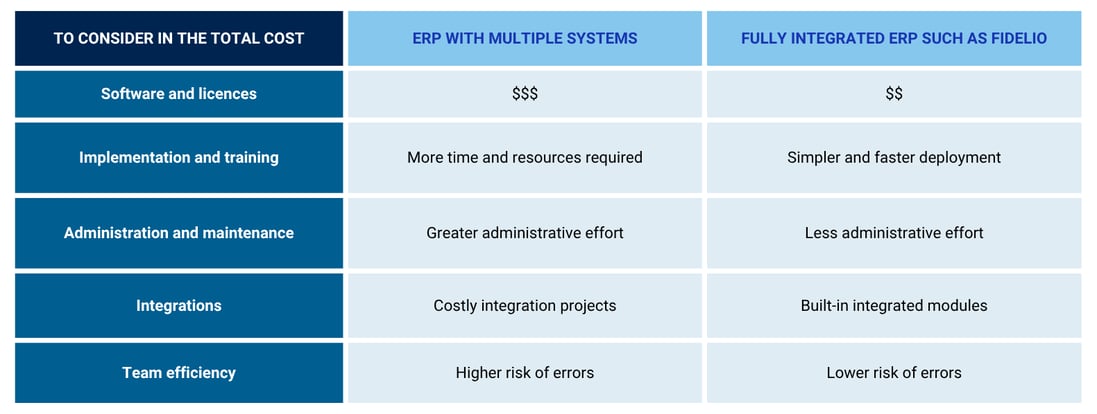
The subscription cost of an ERP solution represents only a portion of its actual cost. To make a meaningful comparison, businesses must consider licences, implementation, training, maintenance, integrations, required resources, and the inefficiencies that may develop within operations.
The comparison should therefore focus on the entire environment needed to run the business, not solely on the ERP software itself. A fully-integrated ERP solution such as Fidelio reduces the number of systems, integrations, and certain manual processes by consolidating multiple functions within a single environment.
Beyond the purchase price, it is the total cost and the long-term value created for the business that should ultimately guide the selection of an ERP solution.
To learn more about the costs of a cloud ERP system, read our post, “Is Cloud ERP a Cost or an Investment? Building the Business Case for Investment”
If you have more questions, do reach out to us.


.svg)